Interview by Luca Violo to Lady Carolyn Hanbury
The Quakers believe that a garden should reflect a divine order in which science, beauty and religion interact.
I find that this is still evident today, and credit is due to the University for not having attempted to turn it into a park or to use it as a money-making scheme, but rather for having left it as close to nature as possible, so that it retains a spirit of tranquillity and timelessness.
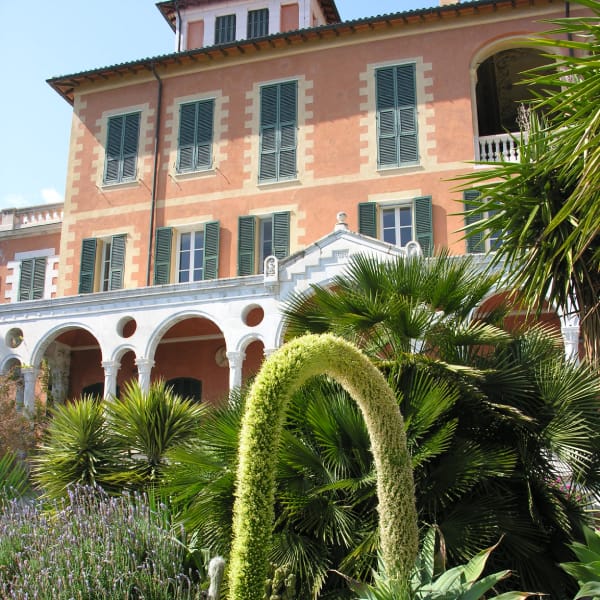
The Hanbury Botanical Gardens, situated in the hamlet of Mortola in the province of Ventimiglia, tell the story of a transformation which, over more than a century and a half of family history, has made them among the most famous in the world. A dynasty which, over time, has transformed this enchanting palace – formerly owned by the Orengo family – into a lush paradise on earth. With your heart and mind, amidst botanical eclecticism and family anecdotes, what do these Gardens mean to you?
They mean a great deal to me: even after 60 years of state ownership, there is a certain family spirit in the Garden and in the love that has been poured into it for over 100 years. When I first came to live in the gardens in 1995, I was rather daunted by the sheer scale of the project and felt as though I were losing my sense of self. I was overwhelmed by the history of the Hanburys. Then my husband fell ill with cancer in 1996 and died in 1997; afterwards, I found it therapeutic to try to realise everything he had dreamt of doing in our home and to promote the gardens he loved so much, and I gladly took up the mantle of the Hanbury family – except that my husband was the gardener and I don’t have green fingers, which can be a bit embarrassing when you have such a famous surname! I enjoy entertaining, telling the family’s story and meeting lots of different people.
The Quakers believe that a garden should reflect a divine order in which science, beauty and religion interact. I find that this is still evident today, and credit is due to the University for not having attempted to turn it into a park or to use it as a money-making scheme, but rather for leaving it as close to nature as possible, so that it retains a spirit of tranquillity and timelessness.
It makes me smile that Thomas, whilst being a wonderful father who loved his family and also a shrewd businessman, once said that children are a more uncertain investment than plants!
He created a historic garden with a rich botanical collection and a strong horticultural tradition. He left behind a philanthropic spirit and brought prosperity to the area. This endures to this day.
The history of the Gardens began on 2 May 1867, when Thomas Hanbury purchased the Palace and part of the garden from the Orengo and Grandis families for 50,000 francs. A man who led an adventurous and successful life, he was the heir to a wealthy English family. Who was Thomas, and what was his background?
No garden is complete without the story of the family that created it. Sir Thomas was born in 1832, the fourth of seven children, in Clapham, a small town near London. His family owned a pharmaceutical company called Allen & Hanbury. In 1853, his father lent him 6,000 pounds to invest in a new import firm, with a view to setting up a trading business in Shanghai. Thomas learnt Mandarin and was the first foreigner to be elected to the Municipal Council, campaigning to ensure that Chinese people living in the areas reserved for foreigners also had the right to stand for election. His Quaker beliefs in charity, honesty and hard work meant that the Chinese trusted him and were keen to do business with him in silk, cotton and property. He owned 1,500 properties when, at the age of 34, he left Shanghai in 1867; no foreigner had ever owned so much in China. He was very wealthy. His asthma had worsened following his stay in China, and his brother Daniel, who ran the pharmaceutical company and was the person closest to his heart, persuaded him to move to the south of France. They arrived there from London on a ship that had sailed from Menton to Capo Mortola in March 1867. They purchased the mansion and the 18-hectare garden from the Orengo and Grandis families and, with the help of Daniel, his brother who was an excellent botanist, they planned to plant exotic plants from all over the subtropical world.
At the outset of the Gardens’ history, the contribution of the agronomist and landscape architect Ludwig Winter was fundamental. What was the microclimate of the area like at the start of this landscaping venture?
t was a typically Mediterranean climate, rather arid and rocky, with few terraces and shallow soil. When Ludwig Winter took charge in 1868, he and Thomas and Daniel Hanbury had to tackle the problem of soil erosion caused by autumn rains through major land-shaping works; they also had to install irrigation systems to cope with summer droughts. The works involved redesigning the paths, renovating Palazzo Orengo and the other buildings on the estate, and enhancing the architectural ornamentation of the gardens. The first rose plants were brought over in the autumn of 1867 and came from his father’s garden at Clapham Common; at the same time, plants were purchased from the Huber nurseries in Hyères, Nabonnand in Golfe-Juan and the Thuret garden in Cap d’Antibes. In 1868, plants were sourced from Paris, Montpellier and Kew, thanks in part to connections with scientists, directors of botanical gardens and plant traders. From the very early years, the collections of South African, Australian and American plants attracted the attention of the international scientific community. The plants in the gardens were not merely regarded for their ornamental and exotic qualities, but were also the subject of pharmacological research and studied for their economic significance.
The estate boasted a wealth of microclimates resulting from varying exposure to light and wind, as well as differences in slope and humidity levels. The two brothers and their valued colleague made the most of these conditions, identifying the most favourable ones for the growth of the plants they wished to cultivate. Thus, between the sea and the ancient Roman road, alongside the old olive grove, they planted the citrus orchard, the vegetable garden and the rose garden, sheltered from the salt spray by a restored boundary wall. The Australian forest was planted on the gentle slope above the Roman road, whilst citrus trees were also cultivated below the villa. Further up, the olive grove was retained, whilst to the west and east, species of the Mediterranean scrub were tended. Along the River Sorba, wetland species were planted. It was Winter who then organised the maintenance of the nurseries, the collection of seeds and the training of the local staff who were to work in the gardens.
Between the late nineteenth century and the early years of the last century, the renowned German botanists Gustav Cronemayer, Kurt Dinter and Alwin Berger were invited to Villa Hanbury. What mark did they leave on the further development of the Gardens?
Gustave Cronemayer, curator of the Mortola from 1889 to 1897, strengthened the scientific aspect of the garden, handled correspondence with other botanical gardens, and began compiling the first alphabetical catalogue of plants grown in the open air, which is still constantly updated today. He introduced new species and gave the gardens a more professional feel, and they grew in importance. Together with Thomas Hanbury, he launched the Hortus Mortolensis, a catalogue of all the plants growing outdoors in the garden. This catalogue is still published today. They attempted to cultivate coffee, lychee and sugar, but unfortunately these were tropical plants.
Kurt Dinter continued to expand the catalogue with an ever-growing list of plants. Alwin Berger, a botanist at the Dresden Botanical Garden, was in charge of the herbarium and the library and was an expert on aloe. Among other things, he published the *Florula Mortolensis*, which listed the native species of the area. At the turn of the 20th century, the garden was tended by 40 gardeners.
Seeds were sourced from all over the world; by New Year’s Day, there were 233 flowering species and 5,000 species in the garden, and 400 people were invited to celebrate the count of the flowering plants. Every year, the London Times and the Garden Chronicle published extensive and enthusiastic reports on the occasion.
After the First World War, Cecil Hanbury and his wife Dorothy set about restoring, reorganising and developing the Gardens’ heritage from a horticultural, scientific, historical and artistic perspective. What was their contribution to the modern development of the park?
They doubled the number of plants growing here; they were horticulturists, not botanists. Dorothy had a major influence on the garden; she loved colour and was a passionate landscape designer. Whilst they did not contribute to the scientific aspect, they added greatly to the aesthetic value and beauty of the garden.
It was Dorothy who wanted the scented garden and the small memorial gardens, in memory of the local people who fell during the First World War. In 1919, Dorothy wrote that the garden lacked colour, so she moved all the palm trees to the main avenue. Dorothy had 400 pots in the garden because she loved colour and believed in the saying ‘When in doubt, plant stout’ – when in doubt, plant a nice cluster of identical plants.
I would say that between 1922 and 1938 the garden was truly beautiful, a sought-after destination for royalty and the aristocracy from all over Europe. I imagine that between the two world wars, life here in the gardens must have been like a sumptuous film set, with its intense social life, parties and abundance of beauty. There were 38 gardeners, one of whom was tasked with picking flowers for the house every day! Dorothy loved dancing and entertaining, and she hosted ‘Te’ Dansent’ afternoons.
Daniel Hanbury owned the very first Rolls-Royce Silver Cloud, which he used to drive to La Mortola and Alassio, with another Rolls-Royce in tow to carry his luggage! It was such a romantic and exciting time.
After the Second World War, she was determined to restore the Gardens, which had been severely damaged by the conflict. She had the garden cleared of mines and even received plants from the Botanischer Garten in Berlin. Unfortunately, she was unable to bring her British capital into Italy, so she had to sell a considerable amount of property between Mortola and Ventimiglia to restore the garden, which was reopened to the public in October 1947. In 1953, restored to their former splendour, the Hanbury Gardens welcomed Prince Philip of England and Winston Churchill.
In 1960, Dorothy realised that she could no longer continue to manage the garden and that selling it to the State – which took place in 1961 through the mediation of Giulio Andreotti – would be the best solution. Finally, in 1986, the University of Genoa took over the management of the garden. Dorothy died in 1972. She left behind the following words: “I would like La Mortola to be known as a close and loving friend, full of flowers. Not just a list of plants.”
From the late 18th century onwards, for an English gentleman, a journey to Italy represented a fundamental stage in his education, and for many it became their place of choice to live. What did they bring with them from their ideal model of the Anglo-Saxon landscape, and how did this adapt to the climate and traditions of Italy?
I believe they adopted a horticultural approach that was more open to gardening, introducing new plants and landscape ideas; they had a great love of plants and enjoyed experimenting in the Mediterranean climate. The secret of English gardening lies in composition through the colours, shapes and structure of plants, in horticultural management distinct from botanical studies, and in an innate aesthetic sense that harmoniously combines variety throughout the entire design. Those who visited the Riviera in winter constantly remarked on the abundance and variety of wild and cultivated flowers.
The Gardens bring together Thomas Hanbury’s passion for collecting and studying exotic plants with the aesthetic sensibility of Cecil and Dorothy, who were able to showcase the native species to their best advantage. When you’re strolling through the park, which paths do you enjoy the most?
My favourite route is the path down to the Tempietto, where Dorothy is buried: I love the view from there of the agaves, cypresses and olive trees that frame the Palazzo; there’s such a variety of greenery that it really makes you appreciate the importance of that colour in a garden.
Interview by Luca Violo to Lady Carolyn Hanbury