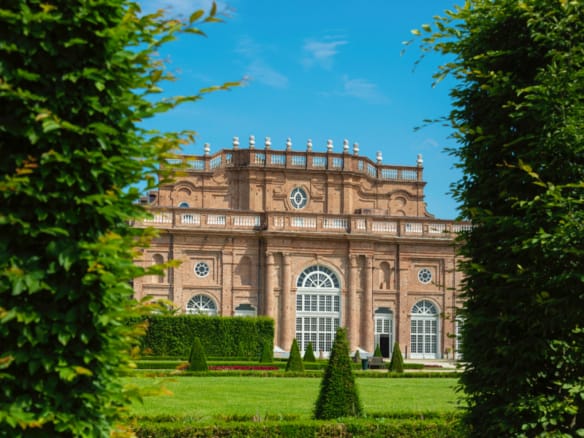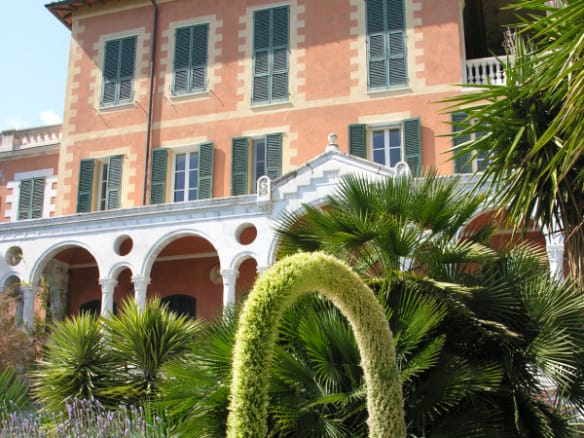
Eclectic and refined, Tomaso Buzzi was one of the leading Italian architects and designers of the 20th century.
His interests were multifaceted and intertwined, fuelled by a boundless creative imagination. He began his career in the 1920s working with Gio Ponti and, between 1932 and 1934, served as artistic director at Venini, where he experimented with new forms of glasswork through fruitful collaboration with Paolo Venini, Pietro Chiesa and Giulio Rosso.
During the 1920s and 1930s, he was one of the leading exponents of Italian Art Deco, and throughout his professional career as an architect and interior designer, he was among the most sought-after figures by the Italian middle classes and aristocracy.
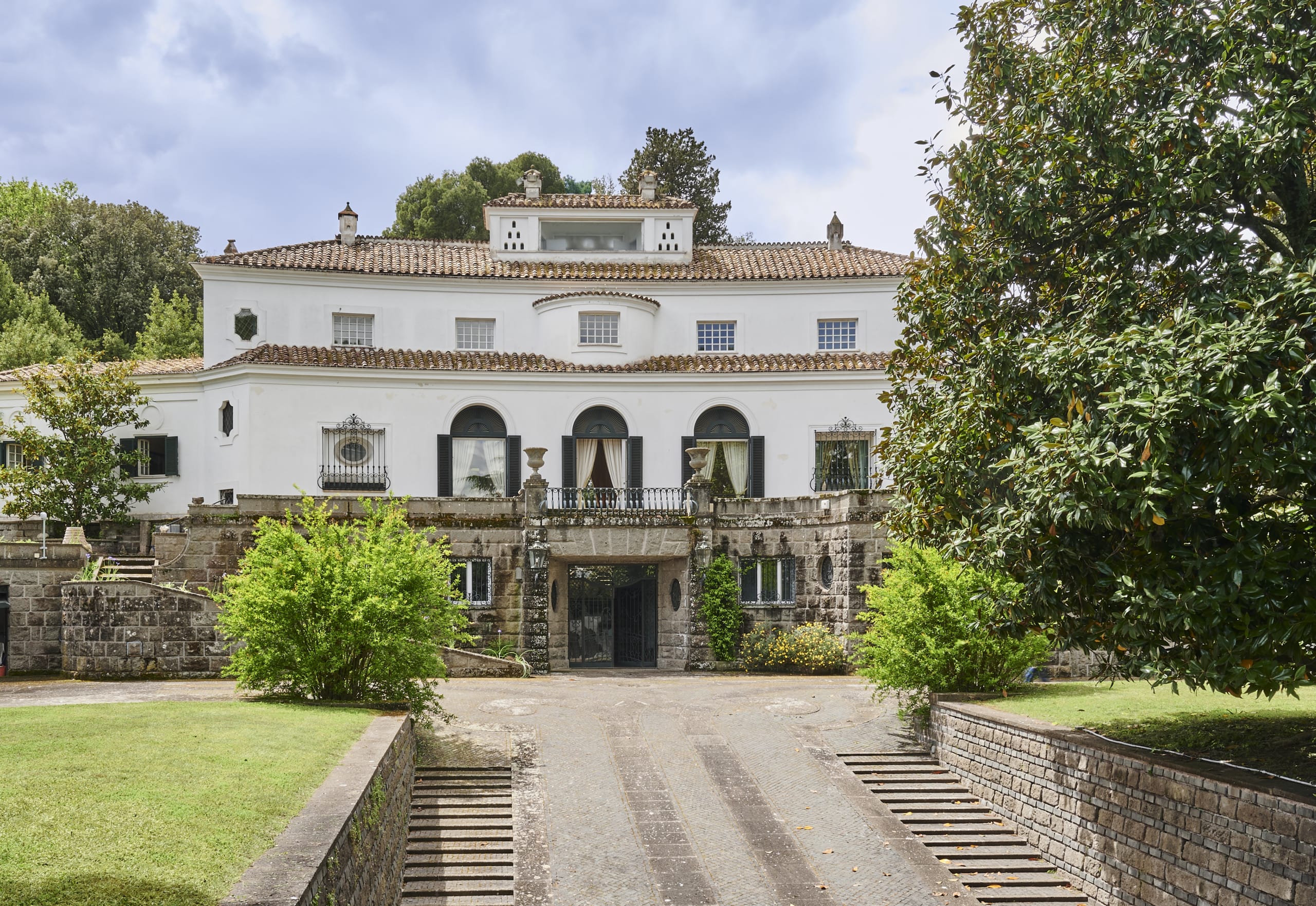
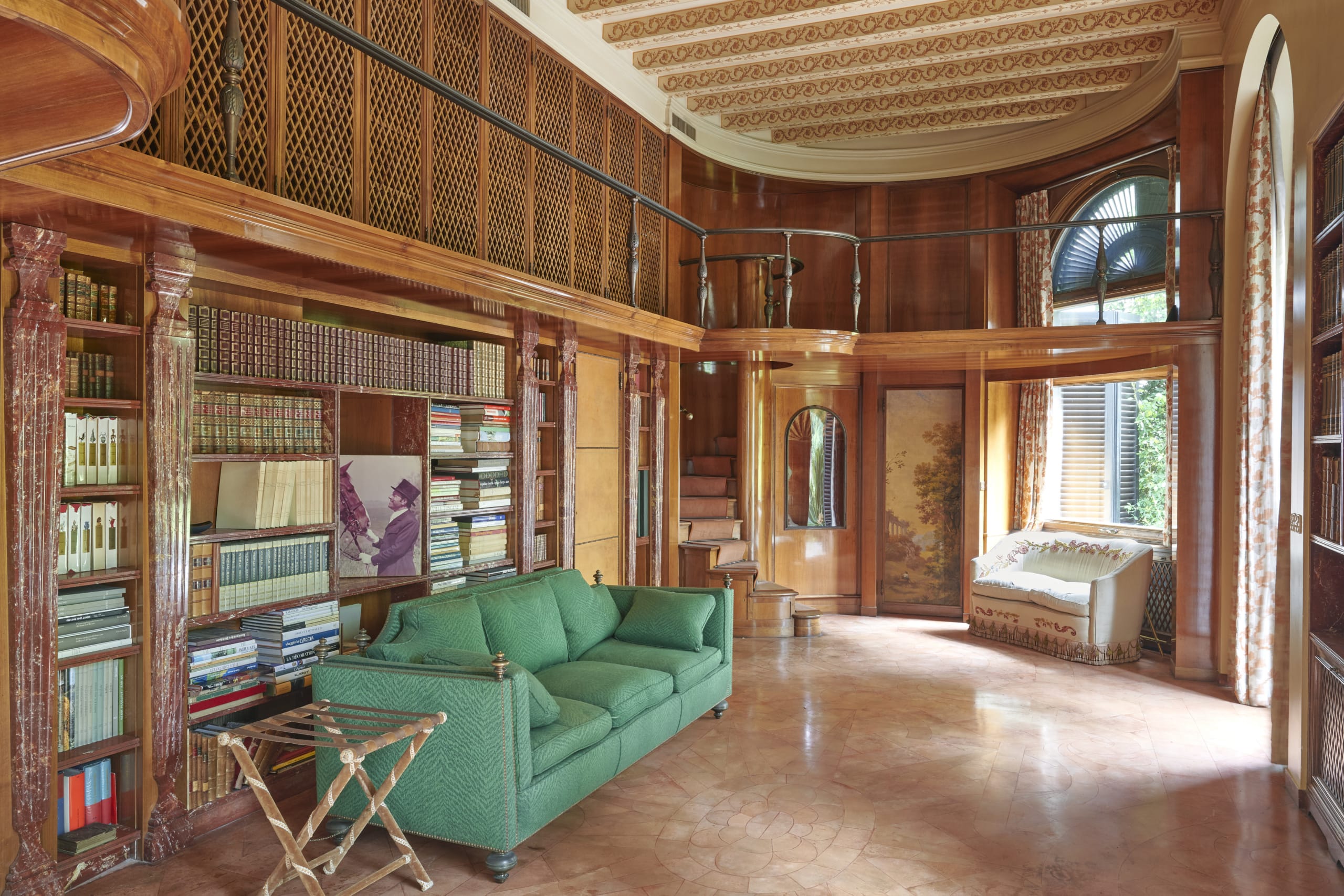
Wannenes Properties – the auction house’s boutique estate agency – presents ‘Villa Palladio’ in Rome, a project of sumptuous aesthetic and architectural beauty designed by Tomaso Buzzi in the late 1950s on commission from the Italian-Swiss diplomat Jean Louis Marcoli.
To gain a better understanding of its myriad artistic, humanistic and cultural facets, we are publishing Maria Luisa Ghianda’s comprehensive article ‘Tomaso Buzzi, a 20th-century starchitect’ (IT), which appeared on 30 September 2022 in the web magazine ‘Doppiozero’.
Perhaps not everyone is aware that Venini’s most famous vase – indeed, the ‘Venini vase’ par excellence – was designed by Tomaso Buzzi (30 September 1900 – 16 February 1981). It is the vase with a rather modest, slightly flattened ovoid body and a moderately elongated neck, resembling the tip of a ‘bùccina’, the wind instrument used by the ancient Romans, from which it most likely draws its inspiration, whilst also evoking vague formal echoes of Oriental art and Etruscan pottery, of which Buzzi was a profound connoisseur, just as he was of all classical art and architecture.
At Venini, where he was one of the leading designers and, for two years, also artistic director, from 1932, when he first joined the company, Tomaso Buzzi introduced a new technique in glassworking, which consisted of ‘developing an original glass texture of his own conception, involving the superimposition of extremely thin layers of coloured glass interspersed with one or two layers of lattimo, equally thin [… ] embellished with the application of gold leaf, resulting in unprecedented shades rich in intensity and nuance’ (M. Barovier).
From that point onwards, this process has become a hallmark of the objects produced by the Murano-based brand – applied even to pieces designed by other artists – as it perfectly highlights its commitment to elegance, grace and refinement. It is thanks to this new technique that Buzzi was able to achieve unprecedented colour effects in his pieces for Venini – rich in subtle nuances that shift with the changing light, making each one a unique object, even though they form part of a limited series. However, his contribution to the success of Murano glassmaking is not limited to the introduction of this technique but has also, and above all, centred on formal innovation. As already mentioned, his profound knowledge of classical and Renaissance art led him to introduce into the art of glassmaking sculptural forms inspired by those artistic cultures, which he always reinterpreted in a highly personal and imaginative way. And so we see bucchera, hydra, kylix, amphorae, globular oikoi, craters, and so on, taking on a glassy form and adorned with delicate colours, featuring elegant and original creative touches that have made them true masterpieces, many of which were exhibited at the 5th Milan Triennale (1933, where they won the Grand Prix) and, the previous year, at the 18th Venice International Art Biennale (one of them was even purchased by the then King of Italy, Vittorio Emanuele III).
However, despite the enduring success of the objects designed by Buzzi for Venini, which continues to this day, the first major exhibition dedicated to them following his death was not held until 2014, thanks to a project by the Giorgio Cini Foundation and the Pentagram Stiftung, accompanied by the publication of a seminal catalogue, edited by Marino Barovier and Carla Sonego (Skira Edizioni), which also serves as a catalogue raisonné of his work.
Decorative Arts
Tomaso Buzzi, described by Federico Zeri as ‘the most cultured of Italian architects’, was born in Sondrio to a wealthy family from Valtellina but made Milan his home. Two years after graduating from the Politecnico di Milano (then the Regio Istituto Tecnico Superiore), in 1925, he designed and built, together with Gio Ponti and Emilio Lancia, the Villa L’Ange Volant in Garches, near Paris, for the silversmith Henry Bouilhet, owner of Christofle. It was in this town that Le Corbusier would later build his famous Villa Stein in 1927.
Following the success of his participation in the Third International Exhibition of Decorative Arts (held in Monza in 1927, which, having moved to Milan in 1933 to the Palazzo dell’Arte – a building specially constructed by Muzio to house it – would become the Triennale), in the famous Sala de Il Labirinto, Buzzi began to devote himself to the discipline which, a few decades later, mutatis mutandis, would come to be known as ‘design’. Il Labirinto, in fact, was a furniture company (whose members included Pietro Chiesa, Emilio Lancia, Michele Marelli, Gio Ponti, Paolo Venini and Countess Carla Visconti di Modrone), similar to the more famous Wiener Werkstätte, which, like its Austrian counterpart, aimed to promote the spread of modern decorative arts in the home and had its showroom in the Venini shop on Via Montenapoleone in Milan. For this company, and subsequently for other artisan workshops, Buzzi would design furniture in fine woods (for the Quarti and Tinarelli firms in Milan), ceramics (for Renato Bassanelli and Aldo Zerbi in Milan, for Richard Ginori, for Prince Borromeo’s small manufactory on Lake Maggiore and for Ilsa in Albisola), glassware, lamps, silverware, clocks and every other kind of home accessory, even fabrics (for the Ravasi factory) and magnificent lace and embroidery, which would prove hugely popular with his elite clientele and play a decisive role in shaping the Italian aesthetic of the 1930s.

However, for these objects we can’t yet talk about design – which implies mass production on an industrial scale – in fact, these are always unique, handcrafted pieces or, at most, items produced in limited editions.
Although, by virtue of his cultural background and by choice, he was utterly averse to modernity – being as passionate as he was about the classical world – he created objects which, like the vase mentioned above and many others, are entitled to be considered modern; or perhaps it would be better to say that they are modern in pectore, because they are so classical as to remain ever relevant and timeless.
As an expert and collector of Etruscan, Roman, Renaissance and eighteenth-century art, Buzzi never imitated their forms and themes, but rather interpreted them in his own personal way, making them his own through his boundless inventiveness, in that unmistakable, highly original and imaginative style which rightly made him famous amongst his contemporaries.
A master draughtsman, from 1938 to 1954 he also held the chair of Life Drawing at the Politecnico di Milano.
Both of these qualities – his profound classical education and his skill in drawing – are the subject of the book, edited by G. A. Cassani, Tomaso Buzzi. The Prince of Architects (1900–1981), published by Mondadori Electa in 2008 (340 pp.).
But Buzzi was also an urban planner; indeed, he took part in the famous competition for Milan’s Master Plan (1926–27) as a member of a prestigious team – comprising the architects Alpago Novello, De Finetti, Muzio, Cablati, Ferrazza, Lancia, Marelli, Ponti, Gadola, Minali, Palumbo and Reggiori – with a project entitled Forma urbis Mediolani, a nod to Bonvesi, which came second, despite being judged the best.
From 1928 to 1934, as editor of Gio Ponti’s Domus and Ugo Ojetti’s Dedalus, he published articles on sixteenth-century architecture, contemporary projects and the subject of gardens, which was also a central focus of his interests.
A high-profile clientele
As if he were one of the architects of the Renaissance, or the Baroque, or perhaps of the Neoclassical period – whose work he knew well and admired immensely – an Andrea Palladio reborn, or a modern-day Donato Bramante, a Jacopo Barozzi da Vignola, or perhaps a Baldassarre Peruzzi, a Michele Sammicheli, or a Vincenzo Scamozzi, if not a Baldassarre Longhera, a Serlio, a Ligorio, or a Juvarra – often listed together in a paratactic manner – Tomaso Buzzi worked for the Italian nobility and business elite, designing their grand, ‘representative’ and spectacular villas, and furnishing their sumptuous apartments; in short, fully embodying their upper-middle-class and aristocratic taste.
He was often a guest at their parties, cocktail receptions, banquets and exclusive gatherings, acting, in part, as the set designer for the ‘dolce vita’ that characterised them.

From the 1930s to the 1960s, In short, he was, in the past, what we would today call a ‘starchitect’ – that is, the architect most sought after by the country’s most influential social classes. Indeed, the furnishings designed by Buzzi – which Roberto Papini, writing in the magazine Emporium, described as standing out “for their slender, exquisite forms, adorned with bronze and silver in the Pompeian style” – enjoyed unquestionable success in high-society salons, such as those of the Necchi Campiglio industrialists, for whom he refurbished, from 1938 onwards, the Milanese villa designed by Piero Portaluppi just a few years earlier. Or for Count Alessandro Contini Bonacossi (the greatest collector and dealer of Italian art of all time) and his wife Vittoria, for whom he carried out, together with Gio Ponti, the refurbishment and complete furnishing of Villa Vittoria in Florence. And then for Count Giuseppe Volpi di Misurata (the founder of Porto Marghera and the Venice Film Festival), for whom, in 1934, he carried out major renovation work on a wing of Villa Maser, which the nobleman had purchased and which his family still owns today. In 1959, for him and his second wife, Nathalie, he designed from scratch the magnificent villa on the beach at Sabaudia, an architectural ‘folie’ that draws on classical Greek and Palladian architecture, reinterpreted in an opulent, grandiose and decidedly Hollywood-style manner. He had also designed a villa for the Marquise Spinola Strozzi in Forte dei Marmi in 1936; in the same year, he had also renovated the Countess of Sangro’s house at 18 Via Sant’Andrea in Milan and worked for the film director George Cukor in Hollywood, as well as for the Counts Volpi in Farfa and for Count Matarazzo at his Villa Forneto in Gradara (Pesaro) and at his villa in São Paulo, Brazil.
The Martini Terraces
Between 1957 and 1958, Tomaso Buzzi designed and furnished the famous Terrazza Martini in Piazza Diaz, Milan, for Martini & Rossi (the company founded by Teofilo Sola, Alessandro Martini and Luigi Rossi). Overlooking the spires of the Duomo, it was a legendary meeting place frequented by Luchino Visconti, Vittorio De Sica, Akira Kurosawa, François Truffaut, Anita Ekberg, Marcello Mastroianni, Christian Barnard, Haile Selassie, Herbert von Karajan, Moravia, Pasolini, Guttuso, Nureyev and many other figures famous in various capacities. Following the one in Milan, Buzzi was commissioned to design the furnishings for many other Martini terraces: in 1960, the one in London, atop New Zealand House; in 1965, the one in Genoa, atop the skyscraper in Piazza Dante designed by Marcello Piacentini, where he incorporated a real caravel as a tribute to Christopher Columbus; and, in 1969, the Terrazza Martini in Rome, on Viale Mazzini, near the RAI headquarters.
In most of the furniture and furnishings he designed, he incorporated the company monogram MR (Martini & Rossi) – which he had devised himself – and which became a logo in its own right, almost a hint of a corporate identity.
For around two decades, the Terrazze Martini served as a true outpost of ‘Made in Italy’; in short, they were authentic ambassadors of Italian taste around the world, helping to promote and spread it through their refined (and somewhat frivolous) elegance.
La Scarzuola
Scarzuola is the name of the site on which stands the 13th-century Franciscan convent, with its extensive adjoining grounds, situated in Montegabbione (Terni), which Buzzi purchased and transformed into his retreat, where he spent the latter part of his life, far from the clamour of the world, reading and drawing, and which today houses his vast archive. He had acquired it in 1956, on the recommendation of Marquis Paolo Misciattelli, at a time in his life and career when he was beginning to sense that the world he had known – and in which he had enjoyed such success – was changing inexorably; he did not recognise himself in those changes and wished to distance himself from them.
La Scarzuola is a theatrical city, into which Buzzi incorporated symbolic and archetypal architectural elements culminating in the acropolis, all inspired by the Hypnerotomachia Poliphili, Francesco Colonna’s illustrated poem, and by Sforzinda, the ideal city designed by Filarete for Francesco Sforza, all imbued with an intense Piranesian spirit.
This is what he himself wrote:
“At La Scarzuola, everything is theatre, and when someone asks me what performances I will stage, I can reply that, for me, the protagonist is silence: the ‘creuse de l’homme’, which is not emptiness.
[…] Only the ruins remain […] La Scarzuola is a miniature Pompeii of a single man, and a man alone. A carcass, an empty shell, a fossilised shell, a skeleton. My dinosaur, a mould, a form (the monologue of an idea), a cry turned to stone, like Echo and the nymph transformed into rock. Alpheus and Arethusa in a spring […] Cyparissus in a cypress, Daphne in a laurel, and so on. The metamorphosis of a man into a stony ruin.
A classical conception that is at once romantic, picturesque and musical; nature that has become architecture and sculpture and literature and music and painting; architecture that becomes nature once more, and sculpture, painting, literature and music.
The dream, the idea turned to stone, and the stone turned to idea. Time—that is, my life—has become stone, a structure, and these structures will be scattered throughout Time.”
Tomaso Buzzi was a magnificent architect and, had he lived in another era – one less ‘blinded’ by the yearning for modernity, and not dominated, as his own was, by ‘rectangular architects’ – to borrow Carlo Emilio Gadda’s apt definition – he would have achieved wider renown amongst the public and critics, rather than merely amongst specialists and enthusiasts, and today he would be studied in schools of architecture and held up as a model of creativity and compositional and formal mastery.
“If I were to write my own epitaph in the style of Stendhal, it would read as follows:
A Milanese
he lived, he drew,
he loved.
This man detested
the Devil,
Mussolini and garlic.”
Yes, because Buzzi remained an anti-fascist even during the regime. Hats off to him!