A cultural real estate asset of international significance, home to the artwork “Naufragio con spettatore”
Claudio Parmiggiani’s installation “Naufragio con spettatore” represents a perfect synthesis of the site’s history and contemporary sensibility. The presence of the work within the nave transforms San Marcellino into a space for reflection, where art, architecture and spirituality converge to create an experience of rare emotional intensity.
In the heart of Parma’s historic centre, San Marcellino stands as one of the city’s most significant examples of Renaissance architecture. Built in its present form in the 16th century on the ruins of an older medieval place of worship, the church still retains the elegance of its original proportions, the grandeur of its single nave and the refined architectural composition that characterises both its façade and interior spaces.
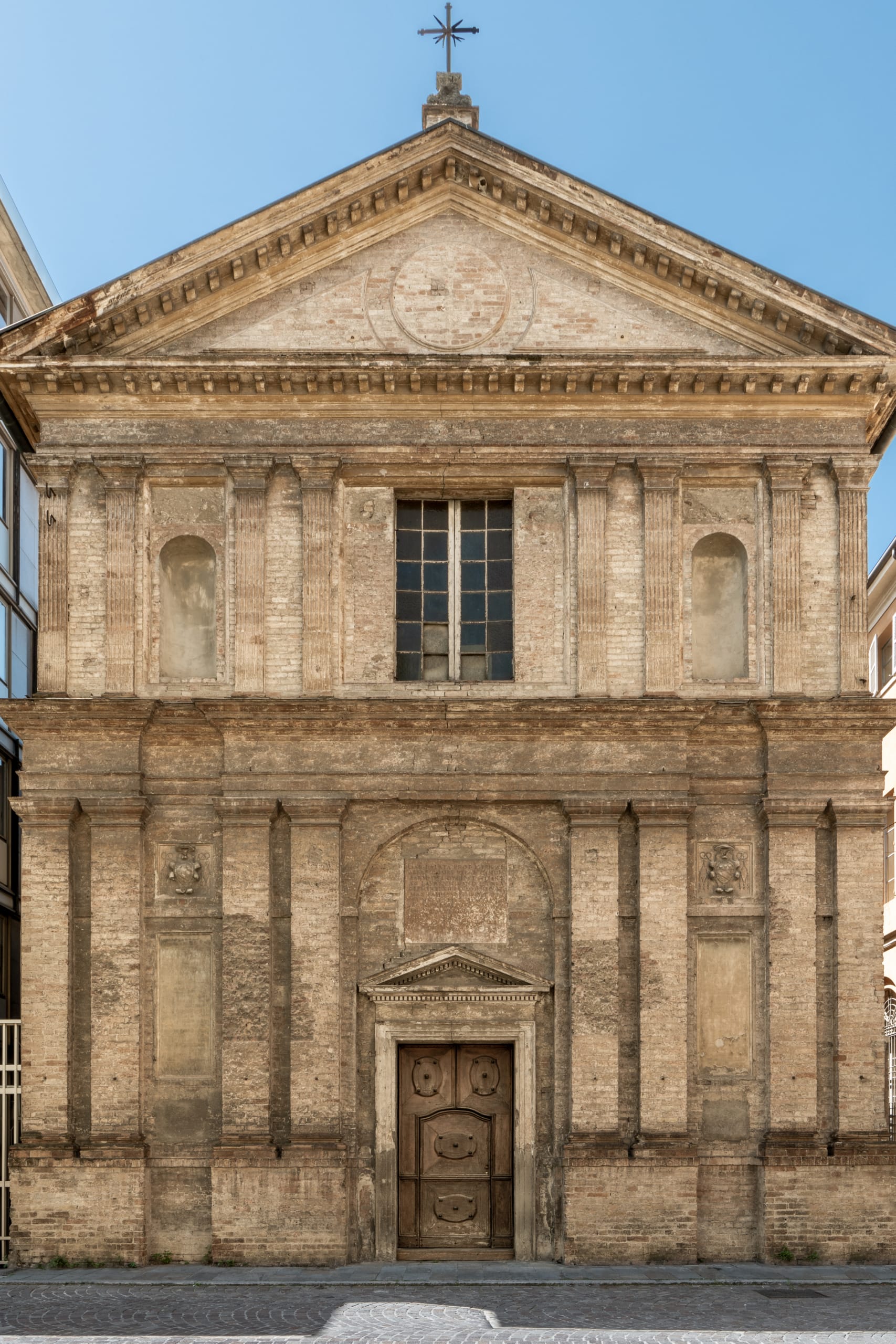
For centuries the centre of the neighbourhood’s religious and cultural life, San Marcellino has accompanied the city’s evolution, surviving urban transformations and preserving a legacy that spans almost a millennium of Parma’s history. Today, the building stands as a rare architectural treasure capable of combining historical identity, cultural value and extraordinary potential for the future.
Located on Strada Collegio dei Nobili, San Marcellino occupies a prime position within Parma’s historic centre, in one of the city’s most historically, culturally and institutionally rich urban settings.
Just a short walk from the main landmarks symbolising Parma’s artistic and academic tradition, the building forms part of an urban landscape characterised by museums, historic palaces, university campuses, foundations and cultural venues of national significance. This location naturally reinforces its public and cultural vocation.
The centrality of the location also allows us to envisage San Marcellino as a new hub for social interaction and cultural production, capable of engaging with the existing heritage and actively contributing to the cultural life of the city and the wider region.
San Marcellino represents not merely the restoration of a historic building, but an opportunity to return to the city one of its most significant and defining landmarks. After centuries of history, this extraordinary Renaissance space now stands as a page still waiting to be written, ready to embrace a new vision capable of combining heritage conservation, cultural production and social value.
The ancient church thus becomes a symbol of rebirth: not the passive preservation of a memory, but its contemporary reinterpretation. In this context, the restoration of San Marcellino embodies the truest meaning of modern patronage, where private investment meets the collective interest, helping to preserve and enhance an asset that is part of Parma’s history and identity.
The presence of Claudio Parmiggiani’s work “Naufragio con spettatore” further reinforces this purpose. The artist’s aesthetic, founded on a dialogue between memory, absence and the passage of time, finds its natural fulfilment in San Marcellino, establishing a profound relationship between historic architecture and contemporary creativity.
The building is no longer merely a container, but becomes itself part of the cultural experience – a place for reflection, contemplation and the creation of meaning. From this perspective, San Marcellino stands as a rare example of a Cultural Real Estate Asset: an architectural heritage capable of generating not only economic value, but also cultural, social and symbolic value. A place destined to once again take centre stage in city life, reaffirming the role of culture as a tool for urban regeneration and as a bridge between the memory of the past and a vision of the future.
THE ARTIST
Claudio Parmiggiani (Luzzara, 1943) is unanimously recognised as one of the most influential and poetic figures in contemporary European art. A figure who is at once reclusive and central to the international art scene, he has, over the course of more than fifty years, built up a rigorous and profoundly original body of work, developing a language that defies classification and finds its fundamental themes in memory, absence, traces and the passage of time.
Trained at the Modena Art Institute and profoundly influenced by his encounter with Giorgio Morandi, Parmiggiani has developed a poetic approach in which the artwork becomes a testimony to the invisible, an evocation of what is no longer present, and a reflection on the persistence of memory.
From the 1970s onwards, he created his famous “Delocazioni” – images produced by depositing smoke and soot on surfaces from which objects, books, statues or musical instruments are subsequently removed. What remains is not the object itself, but its imprint: its absence made visible, transformed into a silent yet powerful presence.
An artist of extraordinary intellectual depth, Parmiggiani has developed a distinctive artistic path independent of the artistic movements of his time, whilst engaging in an ideal dialogue with some of the most significant artistic developments of the second half of the twentieth century. His works have been exhibited in leading international museums, including the Centre Pompidou in Paris, the Grand Palais, the Tel Aviv Museum of Art, BOZAR in Brussels and the French Academy – Villa Medici in Rome, and have been acquired by some of the most prestigious European and international museums.
Among his most emblematic works is “Il Faro d’Islanda” (2000), a permanent installation set within Iceland’s volcanic landscape, a perfect synthesis of his reflection on the relationship between light, memory, space and the infinite.
In Claudio Parmiggiani’s work, memory becomes matter, silence takes shape and absence becomes presence. A body of work of rare intensity that has established him as one of the most profound and recognisable voices in international contemporary art.
THE WORK
“Naufragio con spettatore” is one of Claudio Parmiggiani’s best-known and most significant works. The title refers directly to the famous essay by the German philosopher Hans Blumenberg, in which the ‘shipwreck with a spectator’ becomes a powerful metaphor for the human condition: man observes the drama, risk and precariousness of existence from a seemingly safe position, yet is aware that no one is truly sheltered from fate.
In Parmiggiani’s interpretation, the shipwreck is not merely a physical event, but an existential condition. The boat, a recurring element in his work, becomes a symbol of the human journey, of knowledge, of memory and of fragility. The viewer is not external to the work: they are an integral part of it.
The viewer is called upon to confront the passage of time, loss, that which disappears and that which endures.
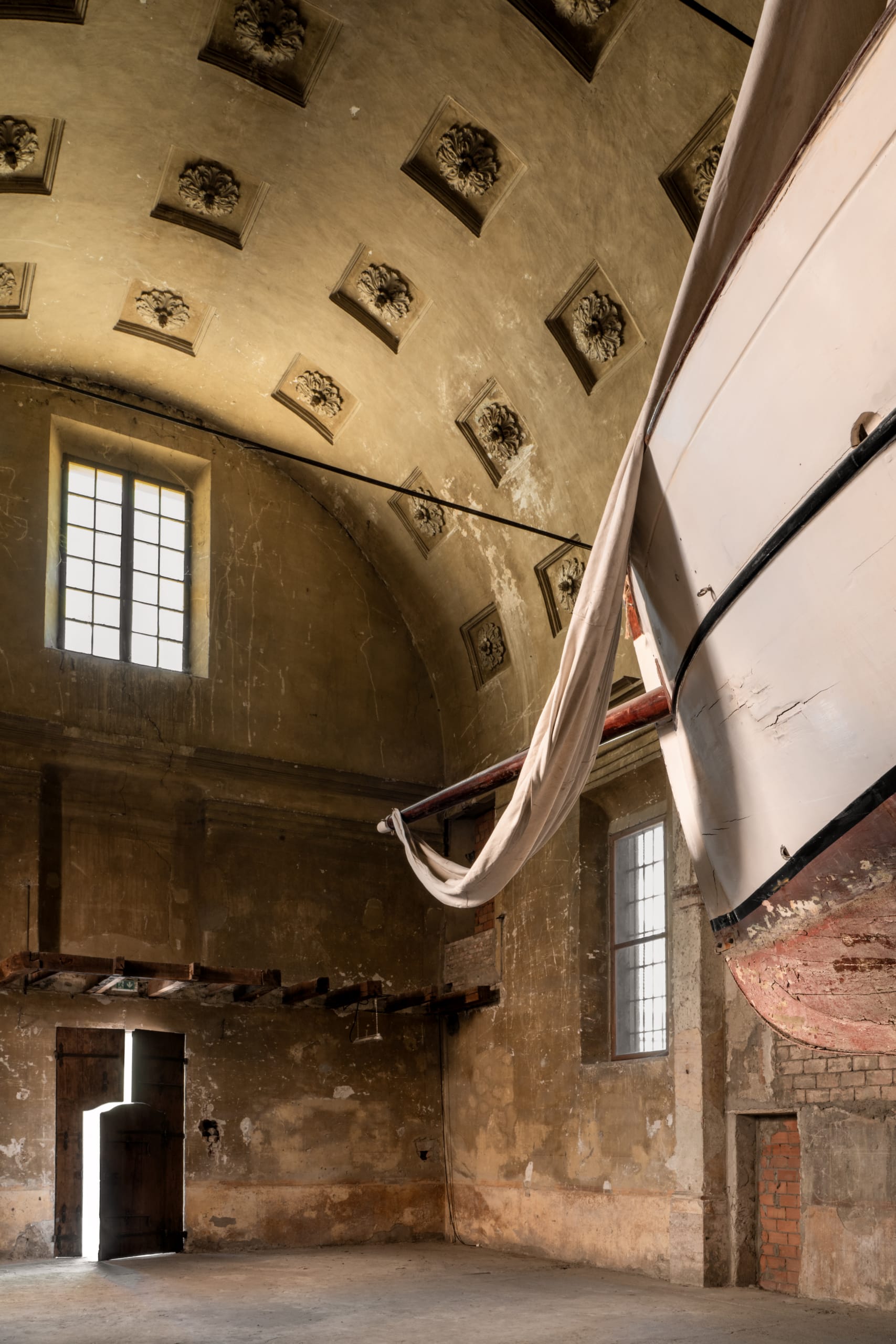
In a setting such as San Marcellino, the work takes on even greater power. The nave of a deconsecrated church becomes, metaphorically, a still sea; the suspended boat seems to traverse a space suspended between earth and sky, between matter and spirit. The Renaissance architecture does not merely serve as a container, but enters into dialogue with the work itself, amplifying its meaning.
«”Naufragio con spettatore” does not depict a catastrophe, but rather the human condition in the face of the mystery of time. The boat suspended in the sacred space of San Marcellino becomes an image of the journey of memory, of the fragility of existence and of the constant search for a safe harbour. The spectator does not merely witness the shipwreck: they silently share its fate.»